Tinnitus
Alan H. Lockwood, M.D., Richard J. Salvi, Ph.D., and Robert
F. Burkard, Ph.D.
Tinnitus is a common yet poorly understood
disorder. Data from the National Center for Health Statistics
show that tinnitus is more common in men than women and increases
in prevalence with advancing age (Figure 1). It is frequently
associated with hearing impairment. Almost 12 percent of men
who are 65 to 74 years of age are affected. Whites are more
frequently affected than blacks, and the prevalence in the South
is almost twice that in the Northeast. Tinnitus may be present
in children, although they rarely make this symptom known. Many
patients with tinnitus believe that they have a serious medical
problem. This is rarely the case. Most treatments are unsuccessful,
and attempts to develop evidence-based therapies have been thwarted
by a poor understanding of the pathophysiology of tinnitus.
In spite of these limitations, in many cases, tinnitus can be
managed satisfactorily.
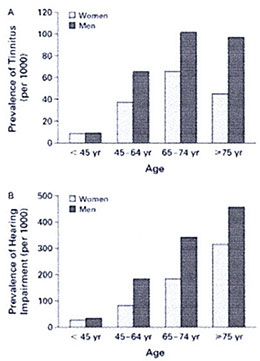 Figure
1. The Prevalence of Tinnitus (Panel A) and Hearing Impairment
(Panel B).
Figure
1. The Prevalence of Tinnitus (Panel A) and Hearing Impairment
(Panel B).
Values are based on responses to the question
"Do you have tinnitus or ringing in the ears [or] deafness
[or] other trouble hearing?" included in the National Center
for Health Statistics survey of noninstitutionalized Americans.
The successful approach to the patient with tinnitus begins
by differentiating objective from subjective tinnitus (Table
1). The failure to make this distinction may lead to diagnostic
and management errors. Patients with objective tinnitus are
hearing real sounds. Pulsatile sounds are reported by about
4 percent of unselected patients with tinnitus3 and are usually
caused by vibrations from turbulent blood flow that reach the
cochlea. An astute observer will link the rhythm of the pulsations,
which may be heard on auscultation, to the cardiac cycle. Some
causes of pulsatile tinnitus are listed in Table 1.
| |
CAUSES of SUBJECTIVE AND OBJECTIVE
TINNITUS. |
|
TYPE
|
CAUSES
|
| Subjective tinnitus |
|
| Otologic |
?noise-induced hearing loss, presbycusis,
otosclerosis, otitis, lmpatcd cerumen sudden deadness, Meniere's
diseease, and other causes of hearing loss |
| Neurologic |
Head injury, whiplash,multiple sclerosisxkrosis,vestibular
schwannoma (common) called an acoustic neuroma or other
cerebellar-pontine-angle tumors |
| lnfectious |
Otitis media and sequelae of Lame disease,
meningitis, syphilis, and other infectious or inflammtatory
processes that affect hearing |
| Drug-related |
Common side effect of many drugs, such
as salicylates, nonsteroidal antiinflamatory. drugs, aminoglycoside
antibiotics.loop diuretics, and chemotherapy amts (e.g ,
ptxins and vincristine) |
| Other |
temporomandibular-joint dysfunction and
other dental disorders |
| Objective tinnitus |
|
| Pulsatile |
Carotid stenosis, arteriovenous malformations,
other vascular anomalies,vascular tumors(e.g., the glomus
jugulare), valvular heart disease (usually aortic stenosis),
states of high cardiac output (anemia and drug-induced high
output) , and other conditions causing turbulent blood flow |
| Muscular or anatomical |
Palatal myoclonus, spasm (if stapedius
or tensor tympani muscle, patulous
Eustachian tube |
| Spontaneous |
Spontaneous otoacoustic emissions |
TABLE 1. CAUSES of SUBJECTIVE
AND OBJECTIVE TINNITUS.
A history taking and physical examination,
followed by neuroradiologic imaging, may identify a treatable
cause. Clicking or low-pitched buzzing may indicate palatal
myoclonus or contractions of the tensor tympani or stapedius
muscle.Occasionally, spontaneous vibrations of the outer hair
cells of the cochlea may produce audible sounds known as spontaneous
otoacoustic emissions. Such sounds are common but are rarely
perceived. The detection of spontaneous otoacoustic emissions
requires special equipment and may not be included in a routine
audiologic examination.
Subjective tinnitus, which we refer to
as tinnitus, is the false perception of sound in the absence
of an acoustic stimulus. Common causes are listed in Table 1.
Many people have episodes of tinnitus that last seconds or minutes
or are transient and associated with exposure to loud sounds
or drugs such as aspirin. These people rarely seek medical attention.
In a series of more than 500 patients, a mean (±SD) of
5.4±8.6 years elapsed between the onset of symptoms and
a request for medical attention. At that time, 60 percent thought
they had a serious problem and 55 percent thought they might
become deaf.
In this same group, 22 percent reported that
the sounds were equal in both ears, 34 percent reported having
unilateral sounds, and most of the others reported a lateral
dominance. Lateralized tinnitus is common and rarely a sign
of a tumor. Sounds were most commonly described as ringing (by
37.5 percent of patients), buzzing (by 11.2 percent), cricket-like
(by 8.5 percent), hissing (by 7.8 percent), whistling (by 6.6
percent), and humming (by 5.3 percent). Most of these patients
reported a high pitch, and 34 percent said that their tinnitus
rated 8 or higher on a 10-point loudness scale, on which 10
was very loud. Reliable, objective measures of the loudness
and pitch of tinnitus are difficult to obtain. In spite of patients'
perception that the sounds were loud, hearing tests showed that
the sounds occurred at intensities that were just barely greater
than the softest sound audible at that frequency. Pitch-matching
studies generally show that the pitch of tinnitus corresponds
to the frequency at which hearing loss becomes clinically significant
(typically above 3000 Hz).
Clinical Approach
The use of a systematic approach to patients,
depicted in Figure 2, should help clinicians avoid errors resulting
from a failure to separate objective from subjective tinnitus,
identify treatable disorders (such as those listed in Table
1), protect hearing, and treat associated problems such as depression,
anxiety, and insomnia. Successful management and a high level
of satisfaction on the part of patients are likely to follow
a thorough evaluation in which sufficient time is allowed to
develop a strong therapeutic relationship.

Figure 2. An Algorithm for the Evaluation
of Patients with Tinnitus.
This approach is based on differentiating
objective from subjective tinnitus; planned, focused laboratory
testing, including audiometry to differentiate cochlear from
retrocochlear lesions; education to preserve patients' hearing;
and an assessment of the effect of tinnitus on the quality of
daily life as a guide to further interventions. Patients with
retrocochlear lesions or objective tinnitus may require referral
to a specialist, additional audiometric testing, or both.
Since tinnitus is usually
a subjective phenomenon, the patient's history and findings
on physical examination are particularly important to differentiate
objective from subjective tinnitus. A clear description of the
sound the patient hears is critical and can be elicited by having
the patient answer the following questions: Is the sound constant
or episodic, unilateral or bilateral? Was the onset sudden or
gradual? How long has it been present? What are the pitch and
loudness of the sound? Is there associated hearing loss, vertigo,
or pain? Is there evidence of other conditions (listed in Table
1) that are associated with tinnitus? (There is a strong correlation
between tinnitus and temporomandibular-joint and other craniomandibular
disorders.) What else affects tinnitus — background noise,
alcohol, stress, or sleeplessness? Is there a history of exposure
to loud noise, ear infections, otologic surgery, head injuries,
and use of ototoxic drugs? Are there any side effects of tinnitus?
How does tinnitus affect daily life and the ability to function?
The physical examination should focus on the
head and neck and include a careful inspection of the oral cavity,
outer ear, tympanic membranes, cranial nerves (particularly
the fifth, seventh, and eighth), and temporomandibular joint
and auscultation of the heart, carotid arteries, and periaural
region. Clinicians should attempt to associate periodic sounds
with the patient's pulse or palatal movements. After specific
questioning and manipulations, up to 75 percent of patients
with tinnitus indicate that various maneuvers, such as clenching
their jaw, cranial pressure, and eye movements affect the loudness
of their tinnitus.
As shown in Table 1, tinnitus is frequently
a symptom of an associated disease process. Although treatment
of the disease may not relieve tinnitus, an accurate diagnosis
and treatment are important to prevent additional disability.
Common conditions associated with subjective tinnitus that may
require treatment include impacted cerumen, otitis media and
other infectious or inflammatory conditions that affect hearing,
Meniere's disease (associated with low-pitched tinnitus), and
otosclerosis. Drug-induced tinnitus may disappear after the
offending agent is discontinued.
As with other medical conditions, the laboratory
tests ordered depend on the results of an analysis of the patient's
history and the findings on physical examination. Patients with
pulsatile tinnitus should be evaluated for disorders that cause
a high cardiac output (e.g., anemia and hyperthyroidism), valvular
heart disease (especially disease of the aortic valve), and
occlusive cerebrovascular disease (particularly among patients
with risk factors for atherosclerosis).
A comprehensive audiologic evaluation is essential.
To quantify any hearing loss and identify any treatable conductive
component of hearing loss, the test battery should include pure-tone
thresholds (air and bone conduction), measures of acoustic impedance
(tympanometry, acoustic-reflex thresholds), speech audiometry,
and tests for maskability. Unilateral high-frequency hearing
loss combined with poor speech discrimination suggests the possibility
of a tumor, usually a vestibular schwannoma (commonly called
an acoustic neuroma) or a meningioma. Patients with these findings
must undergo additional tests to locate the lesion, such as
tests of auditory brain-stem evoked responses, tone decay, reflex
decay, and measures of vestibular function. Bilateral schwannomas
may occur in patients with neurofibromatosis type 2. When indicated
by audiometric tests, magnetic resonance imaging with gadolinium
enhancement should be obtained.Patients with audiologic evidence
of cochlear damage rarely require radiologic evaluations, since
the results seldom affect the approach to management.
The exact prevalence of hearing loss among
patients with tinnitus is high but difficult to determine. Among
patients with normal hearing, typically defined as audiometric
(or hearing-level) thresholds that are 20 to 25 dB or less at
frequencies ranging from 250 to 8000 Hz, it is likely that many
once had better hearing or have impairments at frequencies higher
than 8000 Hz.
Further hearing loss must be avoided. Since
exposure to noise is a common cause of hearing loss, all sources
of noise exposure should be reviewed. Although regulations of
the Occupational Safety and Health Administration limit the
level of noise exposure in most workplaces, regulations do not
apply to all work areas, and additional ear protection may be
advisable. Personal listening devices, appliances, and power
tools are sources of noise that could cause or exacerbate hearing
loss. A wide variety of hearing protectors is available. The
choice should be based on the intensity of ambient sounds and
occupational or other demands. For example, farmers (whose workplaces
are not covered by Occupational Safety and Health Administration
regulations) may require earmuff-like devices when they operate
machinery, whereas orchestra musicians should be provided with
custom-molded devices that fit into the external auditory meatus
and are designed to attenuate sounds evenly across a broad range
of frequencies. Patients with tinnitus should be instructed
to inquire about all otologic side effects of any new drugs
that are prescribed.
It is important to evaluate the effect of
tinnitus on daily life. Surprisingly, the perceived severity
of tinnitus is unrelated to measurements of its loudness or
pitch. Thus, other methods are required to assess the effect
of tinnitus, and questionnaires have been developed for this
purpose. The effect of tinnitus is greatest in patients who
report physical immobility, sleeplessness, and pain and among
those who are depressed or irritable, who are socially isolated,
or who have psychiatric symptoms. Treating these problems may
reduce the effect of tinnitus, even though the percept is unchanged.
Pathophysiology
The high incidence of cochlear damage led
many to suggest that tinnitus arises in this organ. However,
an origin in the central nervous system is implied by the observation
of tinnitus in patients with complete transections of the auditory
nerve. Functional-imaging studies of three disparate groups
of patients support the central-origin hypothesis, as illustrated
in Figure 3.

Figure 3. Neural Sites That Mediate Tinnitus.
Positron-emission tomography shows foci of
neural activity in auditory cortical sites in the temporal lobe
from a group of patients with tinnitus perceived in the right
ear. The unilaterality of the sites suggests a central origin
of tinnitus, since real sounds presented to the right ear activated
bilateral auditory cortical sites. In Panels A and B, the sites
of activation are projected onto coronal and sagittal planes.
The arrows on the sagittal projection in Panel A identify the
locations of the coronal planes shown in Panel C. In the coronal
planes, the colored foci of activation are superimposed on spatially
averaged magnetic resonance images. The y values represent the
distance of each site from the plane of the anterior commissure.
Data are from Lockwood et al.Additional methodologic details
have been published elsewhere.
Hearing loss leads to a reorganization of the pathways in the
central auditory system. These changes may occur rapidly and
lead to abnormal interactions between auditory and other central
pathways. Analogous changes in the somatosensory system linked
to phantom pain led us to suggest that there are similarities
between neuropathic pain and tinnitus. In patients with gaze-evoked
tinnitus, lateral eye movements fail to produce the inhibition
of the auditory cortex observed in controls. The absence of
this phenomenon, called cross-modal inhibition, may contribute
to the false perception of sounds.
Levine hypothesized that a reduction in auditory-nerve
input leads to disinhibition of the dorsal cochlear nucleus
and an increase in spontaneous activity in the central auditory
system, which is experienced as tinnitus. This mechanism could
explain the temporary ringing sensation that may follow exposure
to noise, the effects of some drugs such as furosemide, and
spontaneous tinnitus in people with normal hearing who are placed
in total silence. Other drugs, such as aspirin, increase the
spontaneous firing rate of the auditory nerve. The complexity
of the changes in the nervous system associated with tinnitus
may explain why it is so resistant to treatment.
Therapy
Many drugs produce tinnitus (a list is available
at http://www.hearusa.com), but despite numerous trials, no
drugs have been approved by the Food and Drug Administration
for the treatment of tinnitus. Many trials have been criticized
because of deficiencies in design, including the lack of appropriate
controls, inappropriate randomization procedures, and poor choices
of end points. In his review of 69 randomized clinical trials,
Dobie concluded that "no treatment can yet be considered
well established in terms of providing replicable long-term
reduction of tinnitus impact, in excess of placebo effects."
In randomized clinical trials, placebo effects are strong and
are attributed in part to the attention these patients receive.
Further pathophysiologically oriented research may yield criteria
that identify subgroups of patients who are responsive to specific
therapies.
Reports that lidocaine abolished tinnitus
raised hopes that other antiarrhythmic drugs would be effective.
Lidocaine must be given intravenously in high doses, has a brief
duration of action, exacerbates tinnitus in some subjects, and
is associated with marked side effects. In an analysis of seven
randomized clinical trials of tocainide, those involving less
than 1200 mg per day showed no benefit, while trials employing
higher doses were either flawed or showed no benefit. Randomized
clinical trials of flecainide and mexiletine were marked by
adverse drug effects in up to 70 percent of the participants
or dropout rates of about 50 percent.
Benzodiazepines have not been effective in
controlling tinnitus or have been used in trials whose results
are uninterpretable. In a randomized clinical trial of 40 subjects,
tinnitus improved in 76 percent of those who received alprazolam,
as compared with 5 percent of those who received placebo. However,
the study was criticized because of an absence of a crossover
design and possible unblinding attributable to sedation. The
use of benzodiazepines should be tempered by reports that tinnitus
may recur after the treatment ends and cause a greater level
of distress. Four randomized clinical trials of carbamazepine
and trials of other anticonvulsants failed to show any benefit.
There are many reasons for testing antidepressants,
particularly the tricyclics, as a treatment for tinnitus. Depression
is relatively common in patients with tinnitus, and tinnitus
may be similar to pain syndromes that are often treated successfully
with tricyclic antidepressants. The most definitive double-blind
randomized clinical trial of nortriptyline included 92 patients
with disabling tinnitus, 38 of whom met standard criteria for
depression.During drug treatment, 43 percent said the severity
of their tinnitus decreased, as compared with 30 percent among
those receiving placebo (P not significant). Nevertheless, 67
percent of the patients in the nortriptyline group (dose, 50
to 150 mg per day) indicated that the drug helped them in some
way, as compared with 40 percent of those randomly assigned
to receive placebo (P=0.008). Factors favoring improvement included
the presence of depression, the presence of insomnia, female
sex, and the absence of musculoskeletal symptoms.
Many patients try complementary or alternative
medical therapies: extracts of Ginkgo biloba and acupuncture
are among the most popular. A recent study reported no benefit
in almost 500 pairs of subjects who were randomly assigned to
receive either G. biloba or placebo. An earlier analysis of
one unpublished and four published randomized clinical trials
of G. biloba concluded that the results of trials were favorable,
but that a firm conclusion about efficacy was not possible.
Differences in the products and end points may explain these
variable results. An analysis of six randomized clinical trials
of acupuncture for tinnitus failed to demonstrate any efficacy.
Tinnitus retraining therapy has gained popularity,
with practitioners reporting improvement in 75 percent of their
patients. The rationale for tinnitus retraining therapy is based
on a physiological model that links negative emotional associations
with tinnitus-related neural activity. Tinnitus retraining therapy
centers use a team of physicians, audiologists, and psychologists
in a program that combines counseling and low-level broad-band
noise generators. This therapy usually takes 1.5 years to complete.
The goal is to habituate the patient to the sounds of tinnitus
rather than to abolish the sounds. Critiques of tinnitus retraining
therapy cite deficiencies related to the choice of control groups,
psychologically oriented outcome measures, subject-selection
processes, and an inability to separate the effects of the noise
generators from those of other components of the treatment.
Other forms of psychologically based therapy, including hypnosis,
relaxation therapy, and biofeedback, have yielded mixed results
that, in general, fail to support their use.
Masking devices cover up the unwanted sounds
and provide relief for some patients who have a response to
masking during the audiologic examination.45 Variations in the
characteristics of tinnitus are not reliable indicators of the
likelihood of the success of masking devices. Hearing aids and
cochlear implants may also provide relief, but they are usually
prescribed to treat hearing loss and not tinnitus.
Although there are reports of improvement
in tinnitus after microvascular decompression of the auditory
nerve, the use of surgical treatments, including nerve transection,
remains controversial. Self-help groups, affiliated with organizations
such as the American Tinnitus Association (http://www.ata.org),
provide useful information and support for some patients.
There are thousands of Web sites with information
on tinnitus, and many patients arrive at the office visit seeking
a specific treatment. The pressure to do something may be intense.
Clinicians must deal with these expectations without using prescriptions
to placate patients. Since no treatment is uniformly effective,
a strong doctor–patient relationship is vital. Education
and reassurance are powerful tools. Since issues related to
the quality of life may be central yet difficult to define or
measure with precision, empirical trials of antidepressants,
anxiolytics, or complementary or alternative medical therapies
may be undertaken after a discussion of the risks and benefits
and the identification of a predefined objective. Many patients
can be treated satisfactorily using this approach.
Supported in part by grants from the National
Institute on Deafness and Other Communication Disorders (RO1
DC 3306 and PO1 DC 3600), the American Tinnitus Association,
the Department of Veterans Affairs (Merit Review), the University
at Buffalo, and the James H. Cummings Foundation of Buffalo,
N.Y.
We are indebted to our many colleagues who have
contributed to our work and reviewed earlier versions of the
manuscript.
Source Information
From the Veterans Affairs Western New York Healthcare
System (A.H.L.); the Departments of Neurology (A.H.L., R.J.S.)
and Communicative Disorders and Sciences (A.H.L., R.J.S., R.F.B.)
and the Center for Hearing and Deafness (A.H.L., R.J.S., R.F.B.),
University at Buffalo; and the Mabie Laboratory, Center for
Positron Emission Tomography, University at Buffalo and Veterans
Affairs Western New York Healthcare System (A.H.L., R.J.S.,
R.F.B.) — all in Buffalo, N.Y.
Address reprint requests to Dr. Lockwood at
the Center for PET (115P), VA Western NY Healthcare System,
3495 Bailey Ave., Buffalo, NY 14215, or at alan@petnet.buffalo.edu.