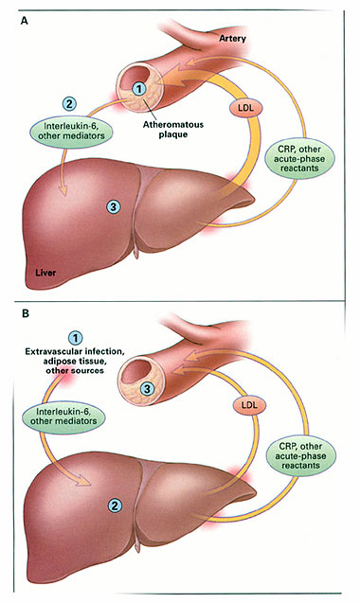
Figure 176
Two Views of the Role of the Acute-Phase
Response in Atherothrombosis.
In Panel A , the uptake of oxidized low-density lipoprotein(LDL) cholesterol
and LDL phosphplipids provokes macrophages and smooth muscle cells within
atheromatas (1) to make C-reactive protein(CRP) and to release interleukin-6
and other mediators(2), which induce the production by the liver of
C-reactive protein and other acute-phase reactants(3). The acute-phase
reactants may or may not contribute to atherothrombosis. Statins inhibit
the synthesis of cholesterol in the liver, increasing the expression
of LDL receptors and thus lowering the LDL level. In Panel B, secretion
of interleukin-6 by adipose tissue or a site of smoldering infection(1)
induces the hepatic production of C-reative protein and many other acute-phase
reactants (2), which enter the circulation and contribute directly to
atherothrombosis(3) in susceptible persons. Statins might inhibit the
production of mediators at the local site(1), intraarterial inflammation(3),
or possibly the hepatic synthesis of acute –phase reactants(2). The
mechanisms represented in Panels A and B could occur simultaneously
in the same person. Arterial infection, if it provoked local inflammation,
would provide an additional stimulus to the acute-phase response (not
shown )