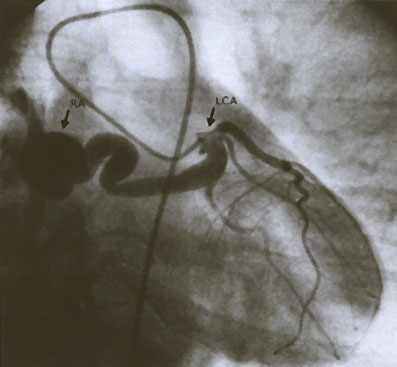
Figure cavf-5
A 25-year-old asymptomatic marathon runner was found during a routine examination to have a continuous murmur that was more pronounced during systole and loudest at the aortic root on the right side of the sternum. Coronary angiography revealed a fistula connecting the left main coronary artery with the right atrium. Since we could not rule out the possibility that this abnormality could result in sudden death during overexertion, the patient was advised to reduce his level of physical activity. In about 55 percent of cases of coronary arteriovenous fistula, the right coronary artery or its branches are the site of the fistula; the left coronary artery is involved in about 35 percent of cases, and both coronary arteries are involved in about 5 percent of cases. The connection between the left main coronary artery (LCA) and the right atrium (RA) is unusual. Drainage occurs into the right ventricle in 41 percent of cases, the right atrium in 26 percent, the pulmonary artery in 17 percent, the left ventricle in 3 percent, and the superior vena cava in 1 percent; in the other 12 percent of cases, there are multiple connections between the fistula and different chambers of the heart. About half the patients with large fistulas are asymptomatic, whereas in the other half, congestive heart failure, infective endocarditis, or myocardial ischemia develops or the fistula ruptures. Pulmonary hypertension may occur when the fistula drains into the pulmonary artery. Survival into adulthood is the rule in these patients, but life expectancy is reduced.
HELMUT BRUSSEE, M.D.and ROBERT GASSER, M.D., PH.D NewEJM, Vol.346, No.12, P904, 3/21/02