This
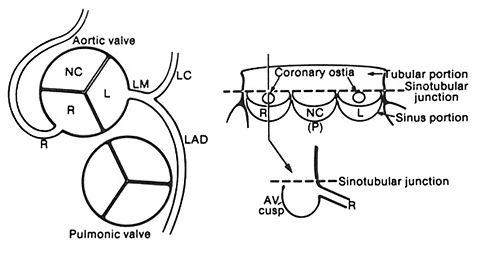
is one of the great arteries of the heart arising from the outflow
tract of the left ventricle to supply oxygenated blood to the
body (see figures 104,
105a and 105b)
and see figures 25 and Figure
29.
Diagnosis and Treatment of Diseases
of the Aorta
Structurally
a simple conduit, the aorta can manifest disease in only a limited
number of ways. When weakened by disease, its wall may dilate,
producing an aneurysm, or it may split in its long axis, producing
dissection. In either case, fatal rupture may result. Moreover,
like all pipes, it may become obstructed. More often than narrowing
of the main trunk, however, obstruction at the origin of a main
branch is encountered. In contrast to these relatively few clinical
manifestations, an array of disease processes can involve the
aorta. Not surprisingly, there is considerable overlap in the
clinical presentation of these disorders.
This chapter will first discuss the various diseases that involve
the aorta together with their pathogenetic mechanisms, characteristic
pathologic features, and typical clinical findings. A description
of the common clinical manifestations of aortic disease for
which there may be several etiologies or for which the etiology
is unknown will follow.
ETIOLOGIC AND PATHOGENETIC CONSIDERATIONS
IN AORTIC DISEASE
Medial Changes of Aging
Circumferential plates or lamellae of elastin
fibers constitute the most conspicuous feature of the aortic
media when it is examined histologically. Dispersed between
the circular elastic fibers are longitudinally oriented smooth
muscle cells, collagen fibers, microfibrils, and ground substance.
Clinicians have long recognized dilatation and elongation of
the aorta in the elderly. Characteristic alterations in the
structure of the aortic wall accompany these changes. Schlatmann
and Beckeridentified these as fragmentation of elastic fibers
and loss of smooth muscle cell nuclei, so-called medionecrosis.
Moreover, collagenous tissue and basophilic ground substance
deposits are a feature of the aging aorta.
Aortic Atherosclerosis
PATHOLOGIC ANATOMY
By middle life, aortic
atherosclerosis is nearly universal in the Western world. ts
severity varies from individual to individual.
Diabetes, hypercholesterolemia, smoking, and
hypertension are among the factors promoting it. The pathology
of atherosclerosis is discussed in elsewhere.
Advanced atherosclerotic changes display a
characteristic distribution, and involvement is most severe
below the renal arteries in the abdominal aorta, is common but
less severe in the descending thoracic segment, and is least
severe in the ascending segment. With diabetes mellitus, however,
disease is frequently severe throughout. Individuals with familial
hypercholesterolemia are a second exception to the rule that
the ascending aorta is spared. Also, the aortic root and aortic
valve may be severely involved in familial cholesterolemia.
Both supravalvular and valvular aortic stenosis may develop.
Finally, syphilitic ascending aortitis promotes severe atherosclerosis.
CLINICAL MANIFESTATIONS
Aortic atherosclerosis is manifest as aneurysm, obstruction
of the infrarenal aorta, embolization from atheromatous plaques
to distal arterial beds, and medial dissection initiated by
penetration of a plaque into the media.
Aneurysm
Aneurysm of the abdominal aorta has long been
presumed to result from penetration into and weakening of the
media by atherosclerosis. Thus abdominal aortic aneurysms characteristically
appear in individuals with the most severe aortic atherosclerosis
in nonaneurysmal segments.
Recent recognition of familial clustering of patients with abdominal
aortic aneurysm, the identification of genetic defects in collagen
in a family with multiple aneurysms' and the detection of abnormal
collagenase and elastase in tissue from aortic aneurysms resected
at operation have led some to the assumption that atherosclerosis
is invariably the underlying pathophysiologic mechanism. These
findings suggest that atherosclerosis represents a secondary
response to dilatation of the aorta resulting from medial weakness.Aneurysm
of the descending thoracic aorta also traditionally has been
attributed to atherosclerosis, since such lesions are commonly
accompanied by an infrarenal aneurysm.
Obstruction of the Terminal Aorta.
Obstruction of the main aortic channel most
often develops in the infrarenal aorta and may extend into the
proximal iliac arteries. Obstruction of branch arteries is more
common than aortic obstruction.
Atheroembolism
The luminal surface of a severely diseased
aortic segment is often rough and covered with thrombus. Embolization
of plaque material and thrombus from these surfaces now appears
to he far more common than was once appreciated. Emboli to the
brain, the lower extremities, and the coronary, renal, or visceral
circulations have been reported.
Transesophageal echocardiography now provides rather startling
views of pedunculated thrombus or other atherosclerotic material
waving in the aortic blood flow ( Fig.
105d ). Aortas with ulcerated plaques, pedunculated or mobile
thrombi, or spontaneous echo contrast are more apt to embolize
than are those with flat, layered atherosclerosis. Anticoagulant
therapy may be protective against future events.
A variation on the theme, the clinical syndrome labeled cholesterol
embolization, with small atherosclerotic particles obstructing
small arteries, is a rare complication of severe aortic atherosclerosis.
Clinical signs include mottled skin and "purple toes"
in the lower extremities together with renal insufficiency and
visceral ischemia in more severe cases.this rarely recognized
condition may he spontaneous but is more commonly encountered
as a complication of intraaortic catheter manipulation. Because
eosinophilia is frequent in the initial phases of this event,
an immune reaction to the free particles has been suggested.
Penetrating Atherosclerotic Ulcers
Atherosclerotic plaque penetration into the
media predisposes to formation of an intramural hematoma. Extension
circumferentially and in the long axis of the media may produce
a limited medial dissection ( Fig.
105e ). Radial extension results in pseudoaneurysm or rupture.
Penetrating ulcers are most commonly recognized in the descending
thoracic aorta.
The clinical picture resembles that of aortic dissection or
of expansion/rupture of a preexisting aneurysm. Sudden onset
of severe back pain in a hypertensive patient or one known to
have atherosclerosis is typical. Many are identified in the
course of imaging for suspected aortic dissection. Since they
are more limited in axial length than typical dissection, and
since they arc located in the descending thoracic aorta, aortic
regurgitation and altered pulses are not characteristic features.
Surgical treatment is often indicated, although some patients
survive without operation.
FIGURE 105d
Panels from transesophageal echocardiographic
examinations of the descending thoracic aorta in four patients.
Varying degrees of atherosclerotic plaquing are illustrated.
A minimal degree is shown in A (upper left) and a more severe
but still moderate degree in B(upper right). C and D demonstrate
protruding plaques, the configuration with the most serious
threat of embolization.
(From Lindsay J.Jr et al. Diseases
of the aorta. In: Schlant RC, Alexander AW, Lipton MJ, eds.
Diagnostic Atlas of the Heart. New York: McGraw-Hill, 1996:319.
Reproduced with permission from the publisher and authors.)
FIGURE 105e
A necropsy specimen from an elderly woman
who died suddenly after having severe back pain suspicious of
aortic dissection. It demonstrates a penetrating atherosclerotic
plaque (upper left) providing communication from the aortic
lumen to an adjacent medial hematoma (bottom). An aortogram
had been negative for dissection, but transesophageal echocardiography
revealed the medial hematoma.
(From Lindsay J Jr et al. Diseases
of the aorta. In: Schlant RC, Alexander AW, Lipton MJ, eds.
Diagnostic Atlas of the Heart. New York: McGrawHill, 1996:321.
Reproduced with permission from the publisher and authors.)
Reference:Lindsay,J.,Jr.,Diagnosis and
Treatment of Diseases of the Aorta, Hurst 's The Heart 10th
edition,pages 2375-2377.
Aortic Dissection
Aortic dissection is an even more common potentially fatal aortic
disease than even rupture of an abdominal aneurysm. Every busy
general hospital will encounter several each year. Because fundamental
differences exist between the pathogenesis, clinical presentation,
and treatment of dissections and those of aneurysms, the confusing
term dissecting aneurysm should he discarded.
PATHOLOGIC ANATOMY
Cleavage of the aortic media in its
long axis by a column of blood characterizes aortic dissection.
The split in the media typically occupies about half the circumference
of the aorta and may extend through its entire length. The plane
of dissection often follows the greater curvature of the ascending
aorta and the arch. In the descending aorta, the path of the
dissection is most often located lateral to the true lumen,
but it may be medial and may spiral "barber pole"
fashion about the long axis."
In classic aortic dissection, the "false channel"
created by this medial hematoma communicates with the "true
lumen" through an intimal tear located near its proximal
end. Such tears typically are single and transverse in orientation,
but exceptions are frequent. Multiple secondary ("reentry")
tears, located more distally along the false channel, are common.
Two patterns predominate. In about two-thirds of instances the
false channel originates in the ascending aorta and the proximal
("entry") tear is located a few centimeters above
the aortic valve. The false channel frequently extends to the
aortoiliac bifurcation ( Fig. 105-f
). Dissections that do not involve the ascending aorta account
for about a quarter of all cases. In them, the proximal tear
most often lies just distal to the left subclavian artery. The
medial hematoma begins in proximity to the origin of the left
subclavian artery and extends distally for varying distances
( Fig. 105-g ).
The most widely applied nomenclature is that
of DeBakey. In this classification, dissections involving the
ascending aorta are type I, whereas those originating beyond
the arch are type III. Type II is limited to the ascending aorta.
Apart from length, many type II dissections are indistinguishable
from type I, but others originate within chronic fusiform dilatation
of the ascending aorta. The Stanford classification applies
type A to any dissection involving the ascending aorta and type
B to those which do not (Fig. 105-h ).
Many medial dissections do not follow these
classic patterns. In some, the hematoma is short and limited
to the arch or to the descending thoracic or abdominal segments.
In another rather frequently encountered variation, an entry
tear is located just beyond the left subclavian artery, but
the dissection extends proximally into the ascending aorta.
There is a subset of patients with the clinical
syndrome of aortic dissection resulting from a medial hematoma
but no intimal tear,as demonstrated by computed tomography,
transesophageal echocardiography, or magnetic resonance imaging.
They are now included under the rubric intramural hematoma.
In one series of patients with medial dissection, about 13 percent
had no demonstrable communicating dtear. The aortic segments
involved with intramural hematoma and the presenting clinical
picture do not differ substantially from those of typical dissection.Aortography
may not identify them because contrast material injected into
the aortic lumen fails to enter the medial hematoma. At present,
the therapeutic strategy for intramural hematoma is the same
as for typical dissection.
Another recently described variation involves
an intimal tear that exposes the underlying media or adventitia
but does not result in a medial hematoma.These lesions are diffficult
to detect with the available imaging techniques.
One additional variety of medial hematoma
is the penetrating attherosclerotic ulcer that disrupts the
aortic media and may create a potential for rupture,false aneurysm
formation,or dissection by hematoma.
FIGURE 105-f
Necropsy specimen demonstrating the features
of a typical proximal aortic dissection. A. The large intimat
rent may be seen a few centimeters above the aortic cusps. B.
The false channel created by the dissecting hematoma is shown.
Notice the cleanly sheared layers of media.
FIGURE
105-g
Artist's depiction of the three major anatomic
patterns of aortic dissection. The left panel illustrates the
most common variety, in which an intimal tear is located just
above the aortic valve, and the medial cleavage plane extends
in the long axis for a varying distance, often to the bifurcation.
The center panel depicts the second most common variety. An
intimal tear is found just beyond the left subclavian artery,
and the medial dissection extends distally. The right panel
depicts an important, but uncommon, variation. From an intimal
tear just distal to the left subclavian artery,the medial dssection
extends both antegrade down the thoracic aorta and rterograge
into the descending desegment.
FIGURE 105h_ab
The major anatomic variations of aortic
dissection as they appear on aortography. A. The dissection
originates in the ascending aorta, as in the left panel in the
diagram (Fig. 105g). Note the proximity of the false channel
to the right coronary artery as well as the aortic regurgitation
that results from loss of support of the valve. B. The dissection
begins distal to the left subdavian artery, as in the center
panel of the diagram. The laterally placed false channel is
less well opacified than the true lumen.
(From Lindsay J Jr. Aortic dissection.
Heart Dis Stroke 1992; 1:69. Reproduced with permission from
the publisher and author.)
Figure 105h_c
C. This dissection involves both the ascending
and descending aortic segments as well as the intervening arch.
At surgery, an intimal tear was found just distal to the left
subclavian artery. This variety is represented in the right
panel in the diagram.
(From Lindsay J Jr. Aortic dissection.
In: Lindsay J Jr, ed. Diseases of the Aorta. Philadelphia: Lea
& Febiger; 1994:137. Reproduced with permission from the
publisher and author.)
These lesions appear almost exclusively in
the middle and distal descending thoracic aorta. Exceptionally,
major branch vessels are threatened. The initial presentation
of a complication of a penetrating plaque (whether partial rupture
or medial dissection) may mimic typical aortic dissection. Surgery
may be indicated in selected patients because external rupture
is a hazard.
Death from aortic dissection most often occurs
from disruption of the outer wall of the false channel opposite
the entrance tear. Rupture of proximal dissection therefore
produces abrupt hemopericardium and cardiac tamponade. Hemorrhage
into the mediastinum or either pleural space may occur, whereas
external rupture of distal dissection often results in a left
hemothorax. Death from external rupture, often abrupt. may be
delayed by temporary cessation of hemorrhage attributable to
falling arterial pressure and increasing tension in the periaortic
tissue. Dramatic clinical syndromes result in those rare instances
in which the false channel ruptures into the right heart chambers
producing a large left-to-right shunt.
In approximately half of patients with proximal
dissection, medial hematoma undermines the support of the aortic
valve leaflets, rendering the valve incompetent. Fortunately,
very serious hemodynamic consequences of aortic regurgitation
appear infrequently during the acute phase.
One or more branch vessels of the aorta become
obstructed by dissection in about half of patients with type
I and in fewer with type III dissection. The results may be
catastrophic, particularly in patients with type I, in whom
the coronary and cerebral circulations are jeopardized. Obstruction
by the dissection of the orifice of one of the coronary arteries
rarely may produce an acute myocardial infarction. Failure to
recognize the underlying process may result in thrombolytic
therapy with disastrous results. Obstruction of renal or splanchnic
arteries may produce life-threatening complications such as
severe hypertension and acute renal failure. The iliac arteries
are the branch arteries most frequently compromised. Although
not immediately life-threatening, narrowing of these arteries
may produce dramatic, painful ischemia of the lower extremities.
The aortic wall containing the medial hematoma
is weakened. If it does not rupture during the acute dissection,
it is often the site of subsequent aneurysm formation. Rupture
of these constitutes a major threat to the survivor of the initial
illness.
PATHOGENESIS
Arterial hypertension is a major factor
in causing aortic dissection in 80 percent of patients. In most
patients, no conclusive evidence of an underlying medial defect
can be identified. Increased arterial pressure must certainly
expose any existing weakness of the aortic wall and may, in
addition, accentuate medial degeneration.
The frequency with which dissecting hematoma
is noted in Marfan's syndrome, in certain other congenital and
heritable conditions, and in experimental lathyrism provides
a strong argument for the importance of an underlying medial
defect in at least some individuals with this disorder. Indeed,
histologic evidence of degeneration of elastin or of smooth
muscle cells in the aortic media of such patients has long been
noted. As noted previously, considerable doubt on the specificity
of the classic histologic findings has been raised. Such findings
are frequently absent in patients with dissection and are remarkably
similar to changes encountered in older patients without dissection.
It seems likely that any fundamental medial defect or defects
may be unrecognizable by light microscopy.
The role of the intimal ("entry")
tear in the genesis of medial dissection is debated. Many investigators
feel that it exposes the media to blood under luminal pressure
and that the resulting shear forces initiate and propagate the
medial cleavage. Others propose that medial weakness leads to
hemorrhage from the vasa vasorum. The resulting intramural hematoma
splits the medial layers. In this hypothesis the intimal tears
are secondary. Instances of medial hematoma in which no intimal
tear can be identified support the existence of this mechanism.
CLINICAL FEATURES
Most common in the fifth through the seventh
decades of life, aortic dissection has been reported in children
as well as the very old. Men are affected at least twice as
commonly as women.
Predisposing Conditions
Certain congenital lesions (e.g., coarctation
and bicuspid aortic valve) are associated with increased frequency
of dissection. A greater-than-expected incidence is encountered
in patients with aortic stenosis even after aortic valve replacement.
The same is true with certain heritable disorders such as Marfan's
and Turner's syndromes.
latrogenic vascular trauma, a complication of cardiac catheterization.
coronary bypass surgery. cardiopulmonary bypass, or intraaortic
balloon counterpulsation, may produce extensive aortic dissection.
Pregnancy, either because of its effects on the aortic wall
or because of attendant hemodynamic stress, has been reported
to predispose to medial dissection. This conclusion has been
based on the fact that half or more of the reports of aortic
dissection in women younger than 40 years have occurred during
pregnancy. Since the total number reported is relatively small
(certainly in relation to the frequency of pregnancy), and since
most reports concern one or a few cases, it is possible that
selective reporting accounts for this association.
History
Sudden, excruciating pain, presumably
attributable to the progress of the medial cleavage, announces
the onset of dissection in 90 percent of instances. Patients
may describe the pain as "cutting," "ripping,"
or "tearing," but such vivid descriptors cannot always
be elicited. Patients will most commonly locate the discomfort
in the anterior chest, somewhat less frequently in the interscapular
area, in the epigastrium, or in the lumbar region. Since these
locations often are the site of pain related to more common
processes (e.g., myocardial infarction or cholecystitis). the
examiner must be alert to the possibility of aortic dissection
in any patient with pain in these sites in whom the more common
diagnoses are not immediately obvious.
Two features of the pain of dissection help
to separate it from that of other conditions. The discomfort
of dissection typically is at its most intense from its inception
and does not build in intensity, as is the case with other disorders
producing severe pain in the trunk. Moreover, it often is located
either simultaneously or sequentially in more than one of the
four sites mentioned earlier.
Suspicion should be aroused particularly by pain occurring both
above and below the diapragm.
When pain is not a prominent featuree,it is usually because
a sudden neurologic episode has diminished the patient's ability
to perceive or report pain. Syncope is the most frequent neurologic
event and a particularly ominous sign. It seems always to reflect
external rupture, almost always of the ascending aorta into
the pericardial space. Less frequently, focal neurologic signs
reflect arterial occlusion of the cerebral or spinal circulation.
Unusually, aortic dissection is nearly painless
even in the absence of a neurologic event. For example, occlusion
of the femoral or the subclavian artery may be the predominant
clinical feature, and arterial embolism may be simulated. Rarely,
the acute episode goes entirely unrecognized by the patient.
In such instances, diagnostic study of patients who have an
abnormal chest x-ray, aortic regurgitation or obstruction of
an arterial branch of the aorta uncovers chronic dissection.
Physical Examination
Although none are diagnostic of dissection,
physical findings that greatly increase the probability of its
presence often can be detected. The murmur of aortic regurgitation
can be heard in about half of all patients with acute type I
dissection. Loss or diminution of an arterial pulse also may
be detected in half. One or both of these cardinal findings
is present in all but a small minority of that subgroup. In
contrast, patients with dissection limited to the descending
aorta less frequently have pulse deficits and uncommonly have
a murmur of aortic regurgitation.
The frequency with which hypertension underlies aortic dissection
has been mentioned. Even those with neither a definitive history
of hypertension nor a measurable blood pressure elevation will
on examination have left ventricular hypertrophy or vascular
changes in the optic fundi indicating a hypotensive history.
Extraordinarily high readings can he encountered, particularly
in those with type III dissection. Renal ischemia, a consequence
of renal artery involvement, has been invoked to explain diastolic
blood pressures that may reach 140 to 160 mmHg or more.
Twenty percent of patients with dissection involving the ascending
aorta present with hypotension. Such a presentation requires
immediate consideration of operative treatment because external
rupture almost always is responsible.
Diagnostic Studies
Of the routine studies, only the chest
x-ray provides diagnostic information of much value. The aortic
shadow is abnormal in 80 to 90 percent of patients but also
may be abnormal in many instances in patients who do not have
dissection. Dilatation of the ascending aorta, reflected by
protrusion of its shadow from the right side of the mediastinum,
is a characteristic finding in proximal dissection. Dilatation
of the aortic knob and descending thoracic aorta is typical
of distal disease. Certain other findings, e.g., progressive
widening of the aortic silhouette on serial films, a lobulated
or serrated margin of the aortic shadow, or a "double lumen"
effect created by a less radiopaque false channel, are uncommon
but more specific. The same may be said for detection of intimal
calcification more than 6 mm inside the margin of the aorta.
For confirmation of the diagnosis, either computed tomography
after intravenous contrast material or transesophageal echocardiography
may be employed. Both have high sensitivity and specificity.
Some believe that magnetic resonance imaging is even more accurate;
however, its value is limited in acutely ill patients because
of the longer imaging time and the relative inaccessibility
of patients during the imaging process.
An aortogram is occasionally required to provide
details of branch vessel involvement. Two aortic channels usually
can be identified because of the variation in intensity and
timing of their opacification (see Fig. 105-h). Moreover, the
aortogram may identify a linear lucency representing the aortic
intima and media separating the two channels. At times the false
channel is not opacified because of thrombosis or because it
does not communicate with the true lumen. In such cases, the
true lumen may appear to be compressed and to lie at a distance
from the margins of the aortic shadow. The resulting appearance
of a thickened aortic wall also can be produced by thrombosis
within an aneurysm, aortitis, or mediastinal hematoma or tumor.
These usually, but not invariably, can be distinguished from
dissection because in these the aortic lumen is not significantly
compressed.
NATURAL HISTORY AND PROGNOSIS
Older reports of aortic dissection must be
used to provide information about its natural history because
virtually all patients in the past 30 years have been operated
on and/or had aggressive antihypertensive treatment. Thirty-five
percent of untreated patients succumb within the initial 24
hours, and 50 percent die within 48 hours. 70 percent by 1 week,
and 80 percent by 2
weeks.
Certain subgroups with widely differing natural histories can
be identified. Hypotension (systolic blood pressure <100
mmHg) usually indicates aortic rupture and nearly certain early
death. Almost all such patients have involvement of the ascending
aorta; one-quarter of those with such involvement present in
this way. Those with distal (type III or type B) dissection
are at the other end of the spectrum with regard to their natural
history. Older reports indicate that about half survive the
acute phase without aggressive treatment. Absent modern therapeutic
intervention, the mortality rate of patients with proximal dissection
who are hypertensive or normotensive is intermediate between
these extremes.
Patients who survive the first 2 weeks continue to experience
a high mortality rate in the first year. About half the survivors
die within 3 months, and an additional 10 percent die within
1 year of the onset of their illness. The few who pass the first
anniversary may expect reasonable longevity. Late deaths may
be due to cerebrovascular complications of hypertension, heart
failure from severe aortic regurgitation, or rupture of a saccular
aneurysm of the residual false channel.
MANAGEMENT
The life-threatening complications of
acute aortic dissection include very severe hypertension, cardiac
tamponade, massive hemorrhage, severe aortic regurgitation,
or ischemic injury to the myocardium, the central nervous system,
and the kidneys.Optimal management requires close surveillance
of the vascular pressures, urine flow, mental status, and neurologic
signs in an intensive care unit. Pain relief relief can be difficult
even with potent narcotics but usually can be obtained with
drug therapy to reduce arterial pressure.A successful outcome
requires that progression of the medial cleavage be halted and
that external rupture of the weakened aortic wall wall be prevented.
In as much as the aortic defect is structural, operative treatment
represents the most effective long term remedy. Aggressive antihypertensive
treatment lessens the stress on the aortic wall and thus the
likelihood of progression of the dissection and of rupture.Such
therapy is widely employed prior to and, in selected instances,
as an alternative to surgical management.
In the acute phase. one of several drug regimens
may be employed to reduce arterial pressure and its rate of
rise. Aggressive use of a beta-blocking agent may he adequate
in patients who present with relatively modest levels of hypertension.
With more severe hypertension, intravenous nitropnusside combined
with a beta-blocking agent may be required. Drug therapy should
aim to lower systolic arterial pressure to 100 to 120 mmHg.
Optimal blood pressure reduction may not he possible if oliguria
(<25 mL/h) or mental confusion appears.
Our intensivists currently prefer intravenous
esmolol as the beta-blocking regimen for acute dissection. Because
of its short half-life (9 min), it can be readily titrated in
these often unstable patients. An initial loading dose of 0.5
mg/kg administered over 1 min is followed by an infusion of
0.05 mg/kg per minute. The infusion rate can be increased at
4-min intervals by 0.05 mg/kg per minute. Rates beyond 0.2 mg/kg
per minute have not been shown to provide added therapeutic
benefit. The substantial amounts of fluid required to maintain
this infusion limit the usefulness of this agent in some patients.
If there is concern for volume excess, labetalol may be employed.
This adrenergicreceptor blocking agent affects both nonselective
beta and alpha-1 receptors. A bolus infusion of 0.25 mg/kg over
2 min is recommended. Additional boluses of 0.25 to 0.5 mg/kg
may be given every 15 min to effect. A cumulative dose of 300
mg should not be exceeded. A continuous infusion may result
in drug accumulation because the half-life of this agent is
5.5 h. Appropriate oral doses of beta-blocking agents can be
given for long-term maintenance after the need for acute beta
blockade has passed.
The ability of intravenous nitroprusside to
reduce arterial pressure promptly and consistently and the ease
with which its hypotensive effects can be titrated recommend
it as the current drug of choice for the patient whose blood
pressure does not respond to beta blockade. As little as 0.5
µg kg per minute may produce the desired result. Occasionally,
as much as 5 µg/kg per minute is necessary. A dose of
10 µg/kg per minute should not be exceeded. A beta-blocking
agent nearly always should be used in conjunction with nitroprusside
because animal data suggest that when used alone, it does not
reduce and may, through reflex mechanisms, enhance the rate
of rise of arterial pressure.
Many potent antihypertensive agents (e.g., hydralazine, minoxidil,
and diazoxide) cannot be recommended because they produce reflex
stimulation of the left ventricle and consequently an increase
in the rate of rise of aortic pressure.
Not all patients with acute aortic dissection
have elevated blood pressure. Hypotension, it has been noted,
may reflect aortic rupture and dictates emergency operation.
Some individuals have pressures only slightly higher than the
100- to 120mmHg target level,and pharmacologic treatment is
of dubiuous value,although beta-adrenergic blockade may be tried
to reduce the rate of rise of aortic pressure.
As noted earlier, operative treatment must
be considered in all patients,but certain subgroups can be recognized
whose clinical presentation dictates the timing of the surgery.
At one extreme are those who are hypotensive on admission and
require emergency operation, as noted. On the other hand,operative
treatment may never be an option in those with comorbid illness.
Further, it may not be justified in those with severe neurologic
injury from the dissection.In these inoperable individuals,antihypertensive
therapy is continued indefinitively by converting the drug regimen
to an oral one that avoids vasodilators.
The appropriateness and urgency of surgery
for aortic dissection depend on its location and the clinical
picture. In cases involving the ascending aorta, operative repair
should be undertaken as soon as the patient can be stabilized
and appropriate diagnostic information compiled. By contrast,
for those with uncomplicated type III (type B) dissection, it
is now believed that operation during the acute phase does not
appear to improve survival beyond that achieved with drug treatment
unless there is intractable pain, uncontrollable hypertension,
or serious organ malperfusion) Those who are relatively good
operative risks may benefit from operation in the subacute or
chronic phase to protect them from rupture of a residual saccular
aneurysm. Risk factors (e.g., age, the presence of chronic obstructive
lung disease, size of aneurysms, and its rate of expansion)
for such late rupture are similar to those of degenerative thoracic
aneurysms.
The surgical technique for aortic dissection
varies with the origin and extent of the dissection. The surgeons's
priman goal is always to remove the proximal (i.e., "entry")
tear and to close the false channel at that site. External rupture
is most frequent just across from the entrance tear, as noted.
For ascending aortic dissection, the procedure consists in transection
of the ascending aorta with use of cardiopulmonary bypass, obliteration
of the false lumen by approximation of the inner and outer walls
of the false channel, and end-to-end anastomosis of the transected
aorta. It is usually necessary to restore vascular continuity
by means of a patch or tube graft. Aortic valve incompetence
secondary to loss of commissural support of the valve leaflets
may be corrected when this repair effectively resuspends the
valve. Other patients may require prosthetic valve replacement
or the use of a composite graft. Surgical mortality approaches
15 to 20 percent ,but varies with the location and extent of
the disease as well as age and comorbid conditions.
Surgical treatment for dissection beginning
in the arch or beyond requires much the same operative approach
as has been described for aneurysms in these locations. The
segment containing the entrance tear is resected, the false
channel obliterated by suture closure of the inner and outer
layers, and excised segment replaced with a graft. The morbidity
and mortality of operative repair of the arch and descending
aorta are somewhat greater than when the ascending aorta is
treated.
Placement of a stent-graft through an endoluminal
approach is being investigated in several centers as a less
morbid approach to the treatment of distal dissection.
Reference:Lindsay,J.,Jr.,Diagnosis and Treatment
of Diseases of the Aorta,Hurst 's The Heart 10th edition, pages2384-2389
ABDOMINAL AORTIC COARCTATION (MIDDLE
AORTIC SYNDROME)
Although rare, hemodynamically significant
narrowing of the descending thoracic or abdominal aorta often
produces lifethreatening hypertension that is surgically correctable.
Although it often appears to be a congenital lesion, it may
result from healed aortitis.' For this reason, some writers
prefer to avoid the term coarctation and label it middle aortic
syndrome.
Although the narrowed aortic segment typically is focal, diffuse
hypoplasia of the abdominal aorta involving the branch arteries
may occur. The renal arteries may he stenosed, hypoplastic,
or thrombosed, resulting in severe hypertension. Visceral artery
narrowing may result in bowel ischemia. Intermittent claudication
from involvement of the iliac arteries is more frequent than
in patients with typical coarctation.
On examination, upper extremity hypertension will be present
together with feeble pulses and hypotension in the legs, findings
similar to those of the more common postductal coarctation.
Attention may be directed to the unusual location of the stenosis
by a bruit in the lumbar or umbilical area.
Operative treatment usually is required because severe hypertension
significantly shortens the life expectancy of patients.
Reference:Lindsay,J.,Jr.,Diagnosis and Treatment
of Diseases of the Aorta,Hurst 's The Heart 10th edition, pages2390.